Full stack developer course
A Full Stack Developer course is a software engineer who is proficient in both front-end (client-side) and back-end (server-side) web development, along with all the necessary underlying technologies like databases and server management. They essentially have the skills to build and maintain a complete web application from start to finish.
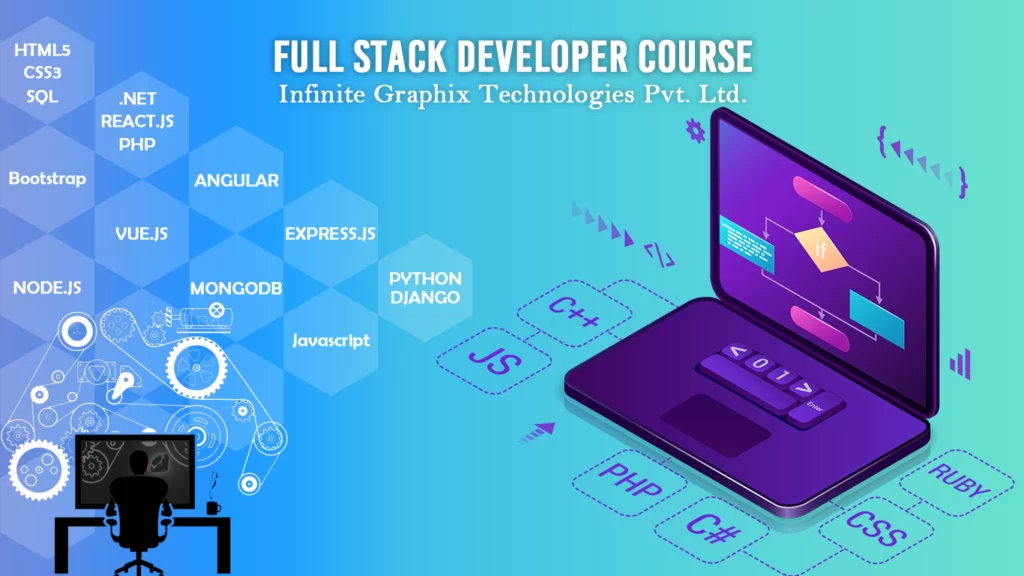
Responsibilities of a Full Stack Developer

A Full Stack Developer’s role is versatile and includes tasks across the entire development spectrum:
Designing the overall application architecture and database schema.
Developing the user-facing features (front-end) and ensuring responsiveness.
Writing server-side logic and connecting it to the database (back-end).
Creating and managing robust and secure APIs.
Testing and debugging the entire application to ensure smooth functionality.
Collaborating with product managers, graphic designers, and other developers to deliver a cohesive product.
Maintaining and upgrading the application post-deployment.
Full stack developers are highly valued for their ability to oversee projects from concept to deployment, providing a holistic view that often leads to better coordination and problem-solving across the entire system. full stack developer is a software engineer
Database Management
This covers how to store, retrieve, and manage application data efficiently.
Database Systems: Learning to work with both SQL (Relational) databases like MySQL or PostgreSQL and NoSQL (Non-Relational) databases like MongoDB.
CRUD Operations: Mastering the fundamental operations (Create, Read, Update, Delete) to interact with the database.
Data Modeling: Designing the optimal structure (schema) for the application’s data.

Development Tools and Practices

1. Agile
Agile is a flexible philosophy and a set of principles that emphasizes iterative development, collaboration, and responding to change over following a strict plan. Its four core values are:
Individuals and interactions over processes and tools.
Working software over comprehensive documentation.
Customer collaboration over contract negotiation.
Responding to change over following a plan.
2. Scrum
Scrum is the most popular Agile framework. It breaks a project into small, fixed-length iterations called sprints (typically 1–4 weeks). Key components include:
Roles: Product Owner, Scrum Master, and Development Team.
Artifacts: Product Backlog (prioritized features), Sprint Backlog (work for the current sprint), and Increment (shippable product piece).
Events: Sprint Planning, Daily Scrum (stand-up), Sprint Review, and Sprint Retrospective.