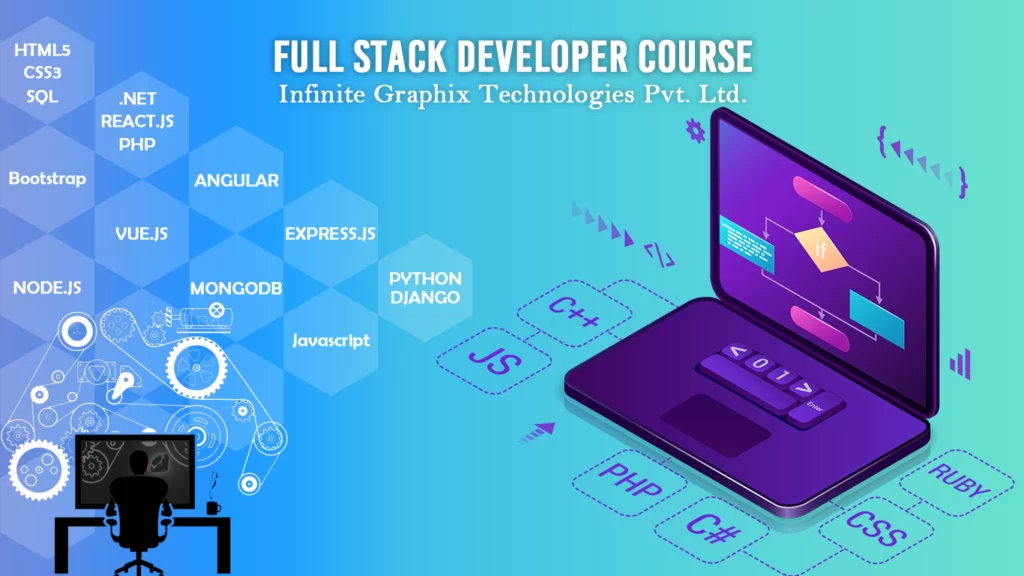
AFull Stack Developer course is a software engineer who is proficient in both front-end (client-side) and back-end (server-side) web development, along with all the necessary underlying technologies like databases and server management. They essentially have the skills to build and maintain a complete web application from start to finish.
Responsibilities of a Full Stack Developer
A Full Stack Developer’s role is versatile and includes tasks across the entire development spectrum:
Designing the overall application architecture and database schema.
Developing the user-facing features (front-end) and ensuring responsiveness.
Writing server-side logic and connecting it to the database (back-end).
Creating and managing robust and secure APIs.
Testing and debugging the entire application to ensure smooth functionality.
Collaborating with product managers, graphic designers, and other developers to deliver a cohesive product.
Maintaining and upgrading the application post-deployment.
Full stack developers are highly valued for their ability to oversee projects from concept to deployment, providing a holistic view that often leads to better coordination and problem-solving across the entire system. full stack developer is a software engineer
Database Management
This covers how to store, retrieve, and manage application data efficiently.
Database Systems: Learning to work with both SQL (Relational) databases like MySQL or PostgreSQL and NoSQL (Non-Relational) databases like MongoDB.
CRUD Operations: Mastering the fundamental operations (Create, Read, Update, Delete) to interact with the database.
Data Modeling: Designing the optimal structure (schema) for the application’s data.
Development Tools and Practices
1. Agile
Agile is a flexible philosophy and a set of principles that emphasizes iterative development,collaboration, and responding to change over following a strict plan. Its four core values are:
Individuals and interactions over processes and tools.
Working software over comprehensive documentation.
Customer collaboration over contract negotiation.
Responding to change over following a plan.
2. Scrum
Scrum is the most popular Agile framework. It breaks a project into small, fixed-length iterations called sprints (typically 1–4 weeks). Key components include:
Roles:Product Owner,Scrum Master, and Development Team.
Artifacts:Product Backlog (prioritized features),Sprint Backlog (work for the current sprint), and Increment (shippable product piece).
Events:Sprint Planning,Daily Scrum (stand-up),Sprint Review, and Sprint Retrospective.
Unlock Your Tech Potential. Build Your Future Expert-led computer training programs designed to launch your career in today’s digital world. Lorem ipsum dolor sit amet, consectetur adipiscing elit. Ut elit
Computer Courses at AIIT COMPUTEER EDUCATION At AIIT COMPUTEER EDUCATION, we offer industry-oriented computer courses designed to help students, graduates, and working professionals build strong technical skills and succeed in
Artificial Intelligence (AI) Artificial Intelligence (AI) is a technology that enables machines and computers to perform tasks that typically require human intelligence. It helps systems learn from data, recognize patterns